Environmental Markets — A strategic opportunity to address inequities in European Agriculture
The EU's agri-food strategy explicitly identifies environmental markets as a strategic tool: a pivotal shift that positions ecosystem services as a legitimate source of income for rural communities.
The European Commission has recently unveiled a strategic roadmap to transform the continent’s agri-food system. With a long-term vision focused on future generations, the initiative aims to build a sector that is more attractive, equitable, and resilient—one capable of delivering sustainability for producers, consumers, and ecosystems alike.
This roadmap is part of a broader agenda that includes the Commission’s recent communication on nature credits, reinforcing the EU’s commitment to high-impact, innovative solutions.
Why is the Environmental Markets Fairness Foundation (EMFF) revisiting this topic?
Because the EU’s agri-food strategy explicitly identifies environmental markets as a strategic tool to achieve its goals. This marks a pivotal shift—one that positions ecosystem services as a legitimate and necessary source of income for rural communities.
At EMFF, we welcome this institutional signal as a decisive opportunity to rebuild trust in environmental markets. If designed with fairness, transparency, and technical rigor, these mechanisms could help resolve the structural price inequities that have long affected European agriculture. At the same time, they open a strategic window for Latin America and the Global South.
European markets are increasingly demanding traceable solutions with integrity and verifiable safeguards. In this context, certified carbon projects with biodiversity co-benefits—when built on robust criteria—can lay the foundation for high-quality nature credits in the future.
A vital sector facing structural imbalances
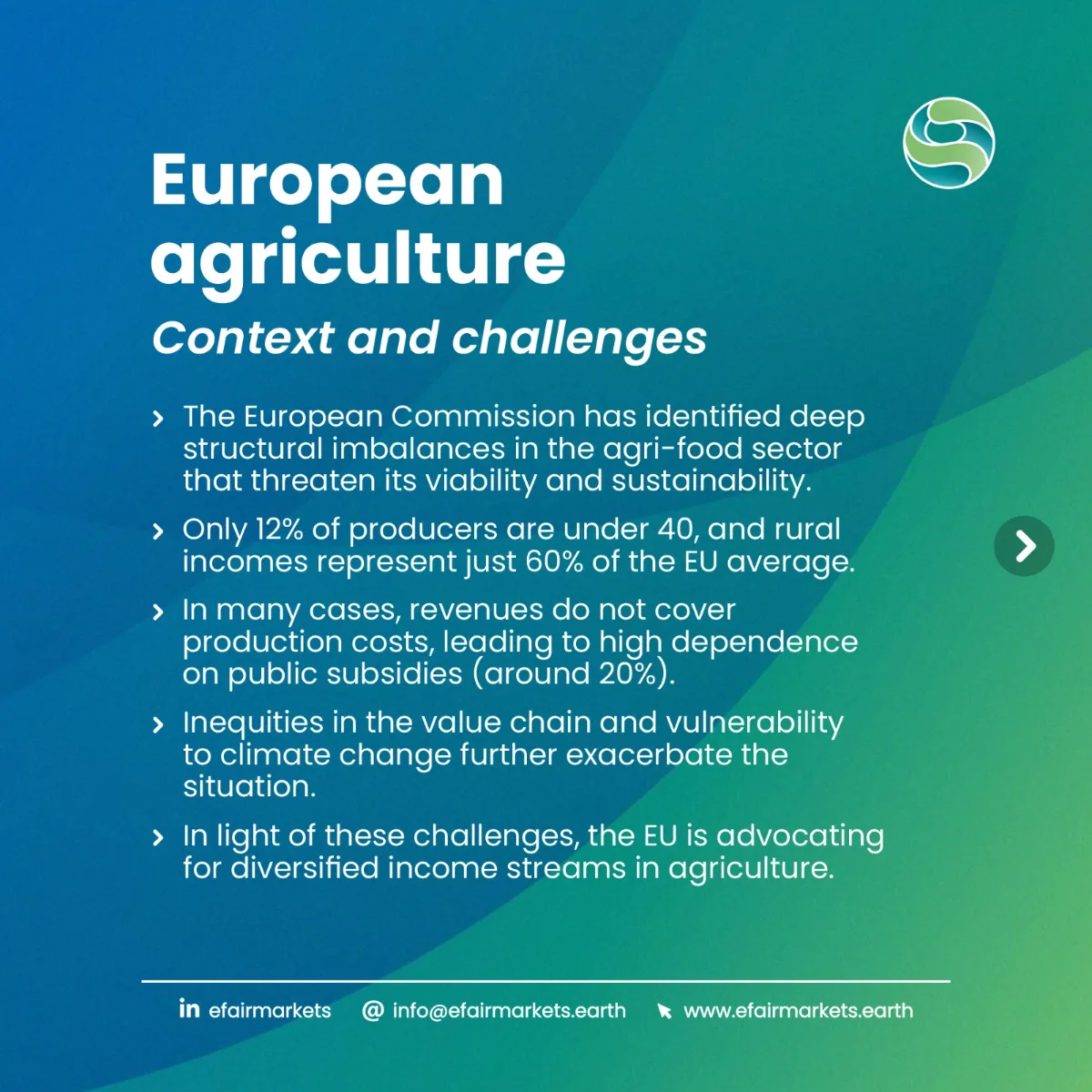
The European Commission’s diagnosis is clear: the agri-food sector is under pressure, and its long-term viability is at risk.
- Only 12% of producers are under the age of 40.
- Rural incomes average just 60% of the EU-wide wage.
- In many cases, sales fail to cover production costs.
- Public subsidies account for roughly 20% of income.
- Climate vulnerability is increasing.
- Inequities along the value chain are deepening.
To address these challenges, the Commission proposes action across three income streams:
- Conventional market revenues
- Public support through subsidies
- New complementary sources—such as environmental markets
Environmental Markets — A pathway to redress inequities
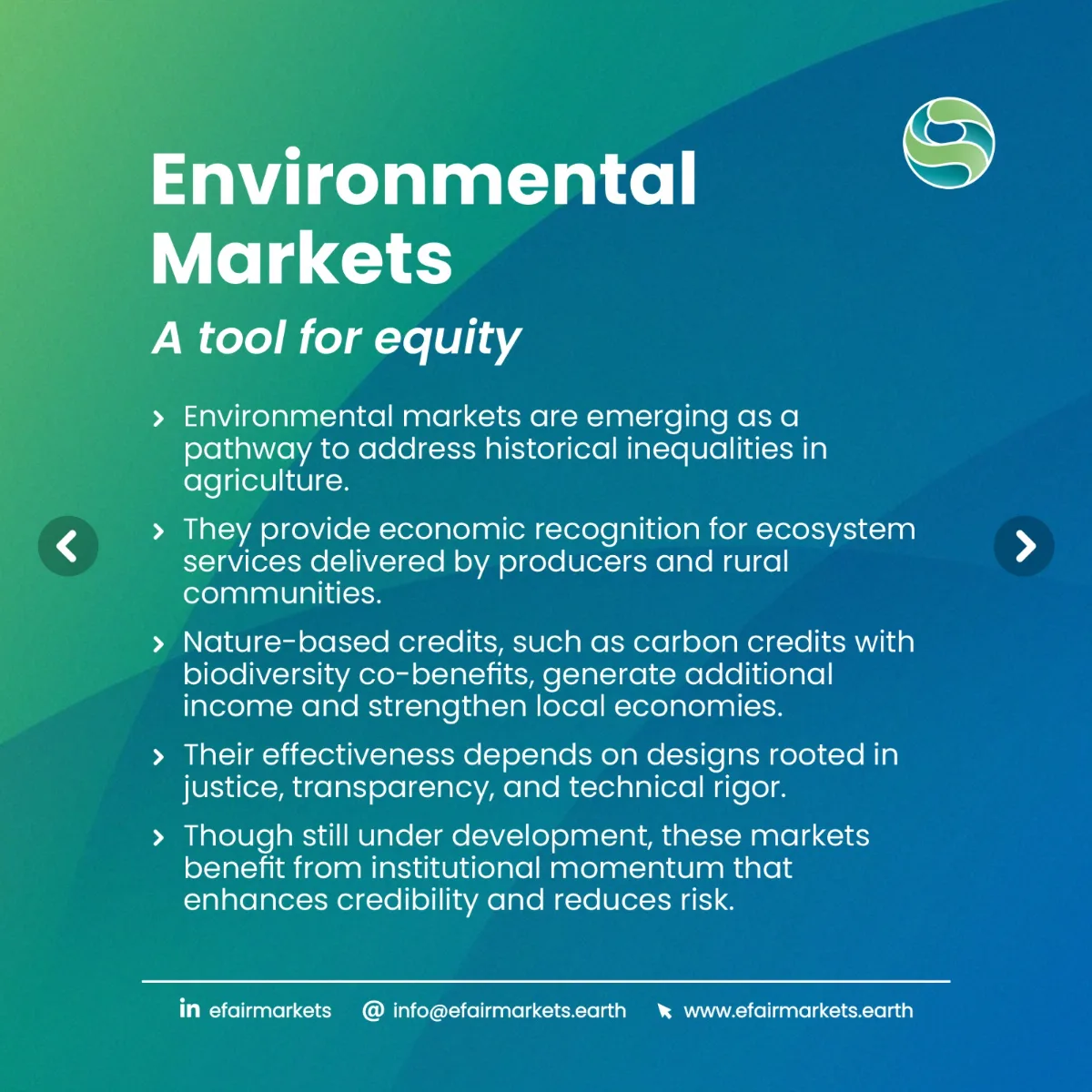
This third pillar is where EMFF’s work is focused. We believe that environmental markets, when backed by clear regulatory frameworks and equity-based principles, can offer tangible solutions to improve conditions in agriculture—by recognizing the economic value of those who manage ecosystems.
Nature credits—such as carbon credits with biodiversity co-benefits—can channel additional income to:
- Agricultural producers
- Fishers
- Local communities
This strengthens the economic viability of rural territories and acknowledges the leadership of those driving the ecological transition.
Market maturity? Not yet. Institutional momentum? Yes—and growing.
While environmental markets are still under development, they are already gaining sustained institutional momentum. This progress is helping to:
- Reduce regulatory uncertainty
- Reinforce the credibility of emerging solutions
- Create new opportunities to integrate production and conservation
In this evolving landscape, income derived from ecosystem services could play a decisive role in revitalizing agriculture—expanding revenue streams and elevating regenerative practices that sequester carbon, restore soils, and protect biodiversity.
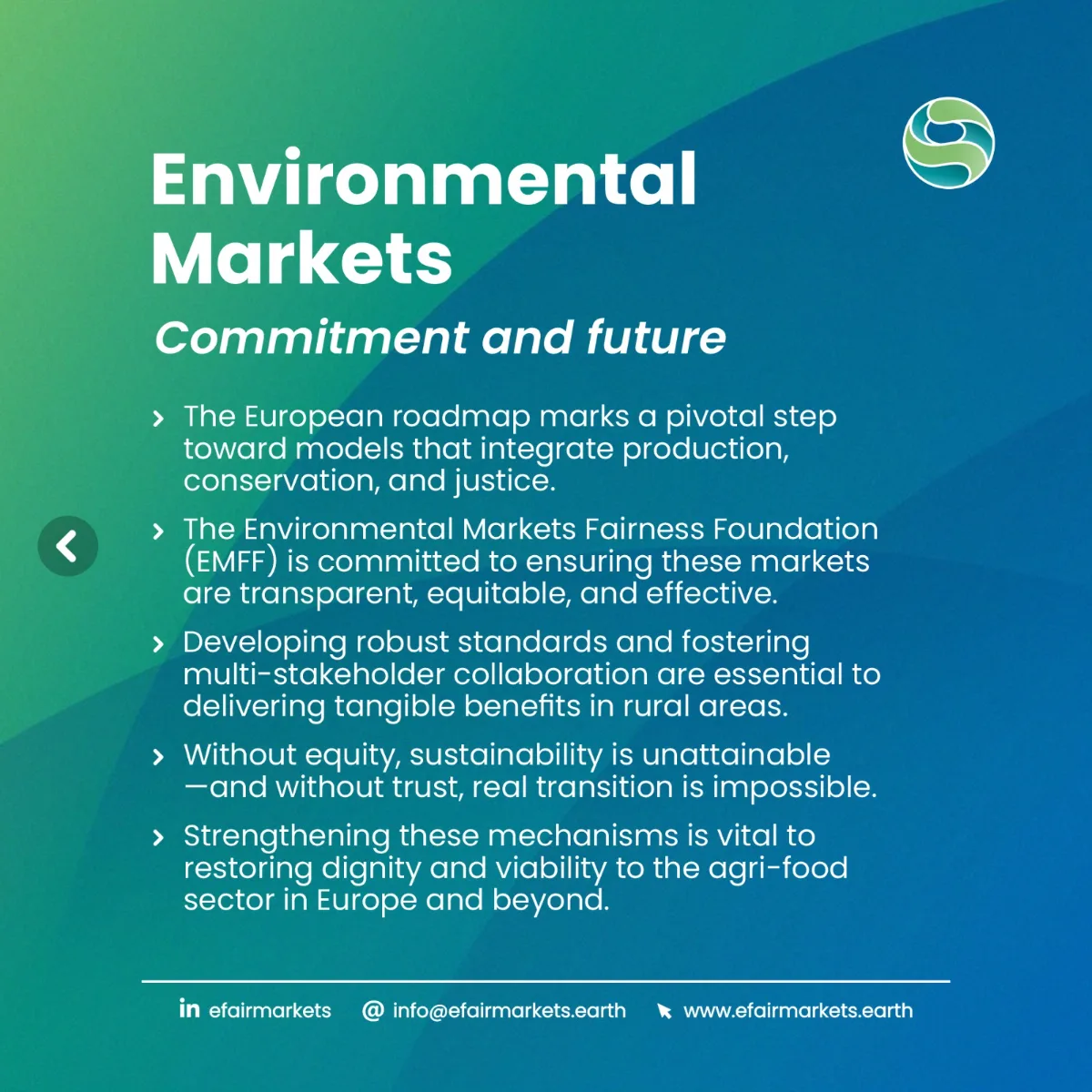
At EMFF, we are actively working to ensure this transition is grounded in justice. We promote standards that guarantee traceability, integrity, and tangible benefits for local territories. We collaborate with governments, businesses, civil society, and multilateral institutions to build a system where environmental markets are not only effective—but also fair.
Contributing to this conversation is a priority. There is still much work ahead to translate these principles into operational mechanisms. But this roadmap marks a meaningful step forward. At EMFF, we believe it can be a turning point toward a model that recognizes and values ecosystem services—and the rights of those who protect them.
Read our full analysis of the EU’s roadmap toward nature credits